KEARNEY – Step inside, lean back and look up.
The University of Nebraska at Kearney Planetarium is ready to launch another semester of stellar shows.
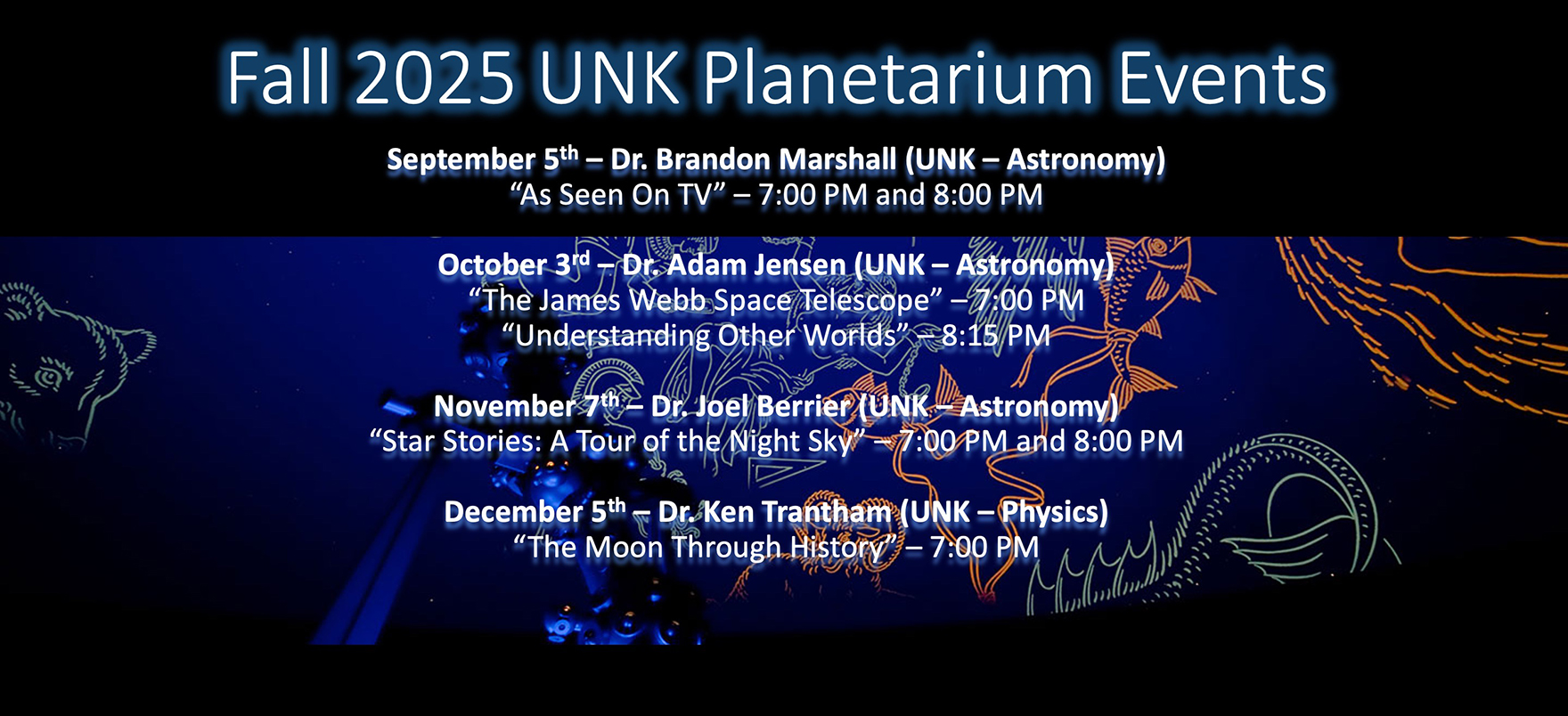
Led by faculty from the UNK Department of Physics and Astronomy, the “Astro Friday” series guides guests through the wonders of the universe while addressing some common cosmic questions.
The fall lineup features:
- 7 and 8 p.m. Sept. 5 – “As Seen on TV,” presented by associate professor Brandon Marshall. Is it actually possible to jam in space? What is the length of the Kessel Run? Can you really outrun the moon’s terminator? In this presentation we will discuss astronomy topics seen in television, movies and pop culture. Did they get it right, or should they have talked to an expert?
- 7 p.m. Oct. 3 – “The James Webb Space Telescope,” presented by professor Adam Jensen. After nearly two decades of project delays and budget overruns, NASA’s next flagship mission, the James Webb Space Telescope, successfully launched on Dec. 25, 2021. Its first full-color images were released on July 12, 2022. This presentation will put these exciting new images into context and give an overview of the capabilities and scientific mission of the telescope.
- 8:15 p.m. Oct. 3 – “Understanding Other Worlds,” presented by Jensen. The last three decades have seen an incredible increase in scientists’ knowledge of planets around other stars, also known as exoplanets. Come and learn about the thousands of exoplanets that have been detected in this time, the billions of exoplanets that are thought to exist in just our own Milky Way Galaxy, and how scientists can analyze their sizes, atmospheres, composition and more – even when in most cases they are not directly seen.
- 7 and 8 p.m. Nov. 7 – “Star Stories: A Tour of the Night Sky,” presented by associate professor Joel Berrier. Modern astronomers use 88 constellations to systematically name stars and designate regions of the sky. These objects are formed by bright stars in our sky that appear to be close to each other. Many of these constellations held specific cultural importance to different civilizations. We will look at several constellations and discuss the myths and legends they are associated with.
- 7 p.m. Dec. 5 – “The Moon Through History,” presented by professor Ken Trantham. The moon has had a great impact on the Earth and human civilization. We will discuss the formation and evolution of the moon, and human perception of the moon throughout history. The origin of lunar phases, eclipses and lunatics will also be discussed.
Admission to the planetarium shows is free, but attendees are required to reserve a ticket at https://www.ticketleap.events/events/unk-planetarium. Tickets will be available one week before each show. Walk-ins will be allowed if seating is available.
Weather permitting, the UNK Astronomy Club will offer telescope observing sessions in conjunction with each show, beginning at 8 p.m. outside the Bruner Hall of Science.
Located inside the Bruner Hall of Science on campus, the UNK Planetarium is accessible and can accommodate one or two wheelchairs per show.
For more information, visit the UNK Planetarium FAQ page or contact Jensen at jensenag@unk.edu.