By TYLER ELLYSON
UNK Communications
KEARNEY – The University of Nebraska at Kearney Department of Mathematics and Statistics has transformed the way students approach one of college’s most common academic hurdles.
And the results are adding up.
Through redesigned courses, streamlined pathways and expanded academic support, the department cut the percentage of students earning D’s and F’s or withdrawing from first-year math classes from 53% in 2021-22 to 29% in 2024-25. That rate dropped to 22% during the fall 2025 semester, with improvements across every course.
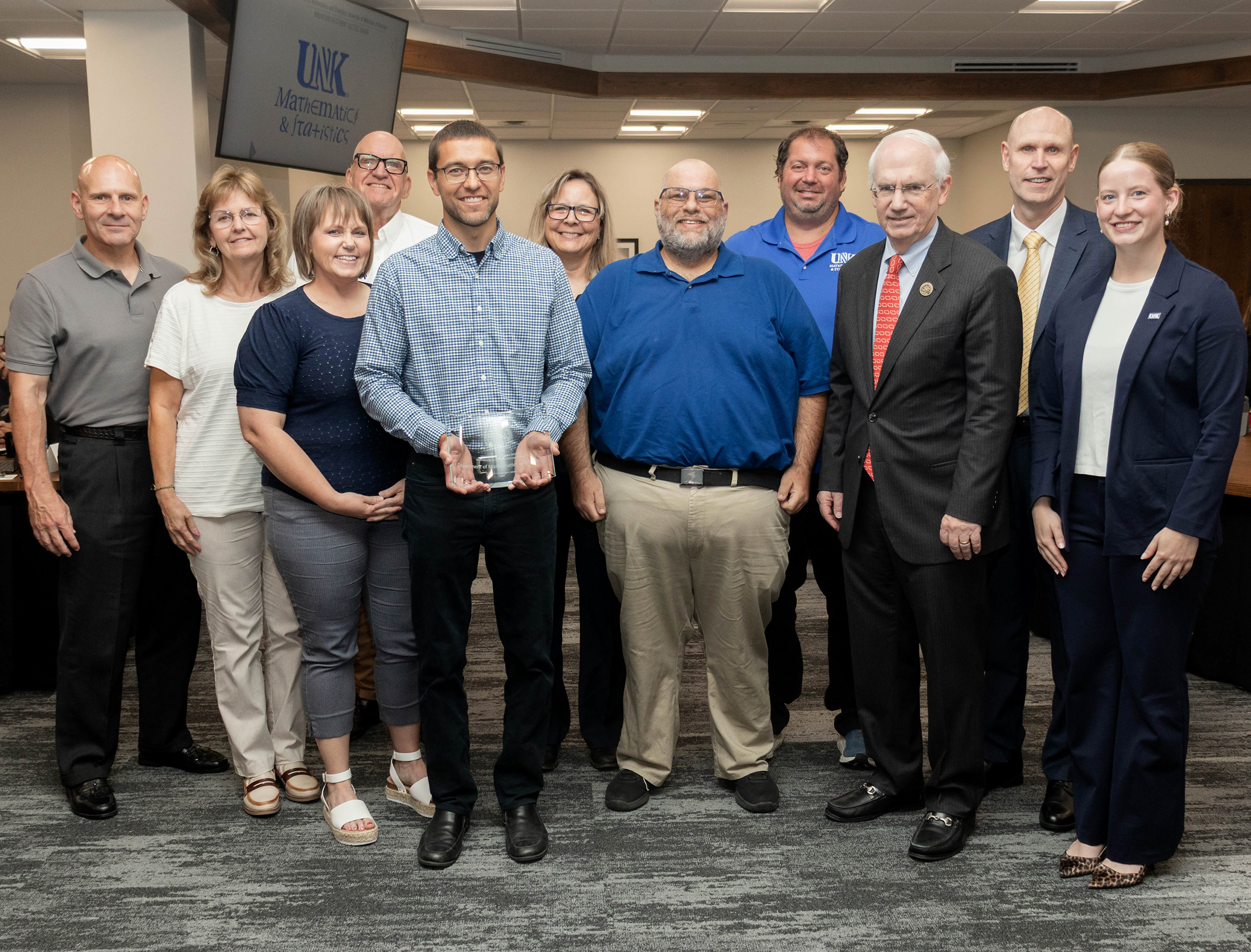
Those efforts earned the department a 2026 President’s Excellence Award, the University of Nebraska System’s highest recognition for faculty achievements in teaching, research and student outcomes. The department received the Innovations in Student Success Award during Thursday’s Board of Regents meeting. The award recognizes a faculty-led or faculty-involved team that has made a significant contribution to improving undergraduate retention and graduation rates.
“This award is recognition that the hard work of our faculty has paid strong dividends,” said associate professor Ted Rupnow, chair of the Department of Mathematics and Statistics. “The confirmation that we are making meaningful changes is in the success of our students, but the award shows that our peers and administrators are recognizing our work.”
Along with an engraved plaque, the UNK department will receive $25,000 in funding, allowing faculty to build on the progress they’ve already made.
“We are excited about what we can accomplish with the financial incentive to improve student success and support retention,” Rupnow said.
Removing barriers
Nearly every UNK undergraduate takes a course through the Department of Math and Statistics because the university’s general education curriculum requires at least three credit hours in mathematics, statistics or quantitative reasoning.
That makes the department an important part of students’ academic progress – and prompted faculty to take a closer look at courses that were creating obstacles.
In 2021-22, the weighted average DFW rate – the percentage of students earning D’s or F’s or withdrawing – was 53% across six common first-year math courses. Individual course rates reached as high as 62%. Some students were also required to complete multiple prerequisite courses that did not fulfill their general education requirement before advancing to the course they actually needed.
Associate professor Scott Gensler, who submitted the award nomination, said the department responded with a comprehensive redesign aimed at removing unnecessary barriers while maintaining academic rigor and strengthening preparation for students who need higher-level mathematics.
Changes included eliminating Elementary Algebra, or Math 90, and opening enrollment in Intermediate Algebra and Mathematics for Liberal Arts. The department also revised placement practices and advising recommendations to help students enter the course that best matches their academic and career goals.
For many non-STEM majors, that means taking Mathematics for Liberal Arts instead of College Algebra, which is primarily designed as preparation for trigonometry and calculus. The department also developed Applied College Algebra and Geometry, a new course designed for programs that require more algebra and geometry but not calculus. These include biology, industrial distribution, construction management, aviation and interior and product design.
Chemistry professor Chris Exstrom, who serves as director of general education at UNK, applauded the updates.
“I have worked with the Math Department on efforts that directly support student retention and on-time graduation,” he said. “The department has been exceptionally proactive in addressing DFW rates and in rethinking how students fulfill their mathematics general education requirement in ways that better align with their academic and career goals.”
Exstrom pointed to the Applied College Algebra and Geometry course as an example of the department’s approach.
“This kind of intentional curricular design is the type of innovation that leads to stronger completion outcomes,” he said.
Improving access and removing barriers has extended to UNK’s growing population of online students, as well. Working with instructional designers, the department developed fully online versions of Math 101, Math 102 and Math 106, giving online students greater flexibility to complete their general education requirements.

Rethinking the classroom
The department’s changes went beyond which courses students take and when they take them. Faculty also reexamined how those courses are taught.
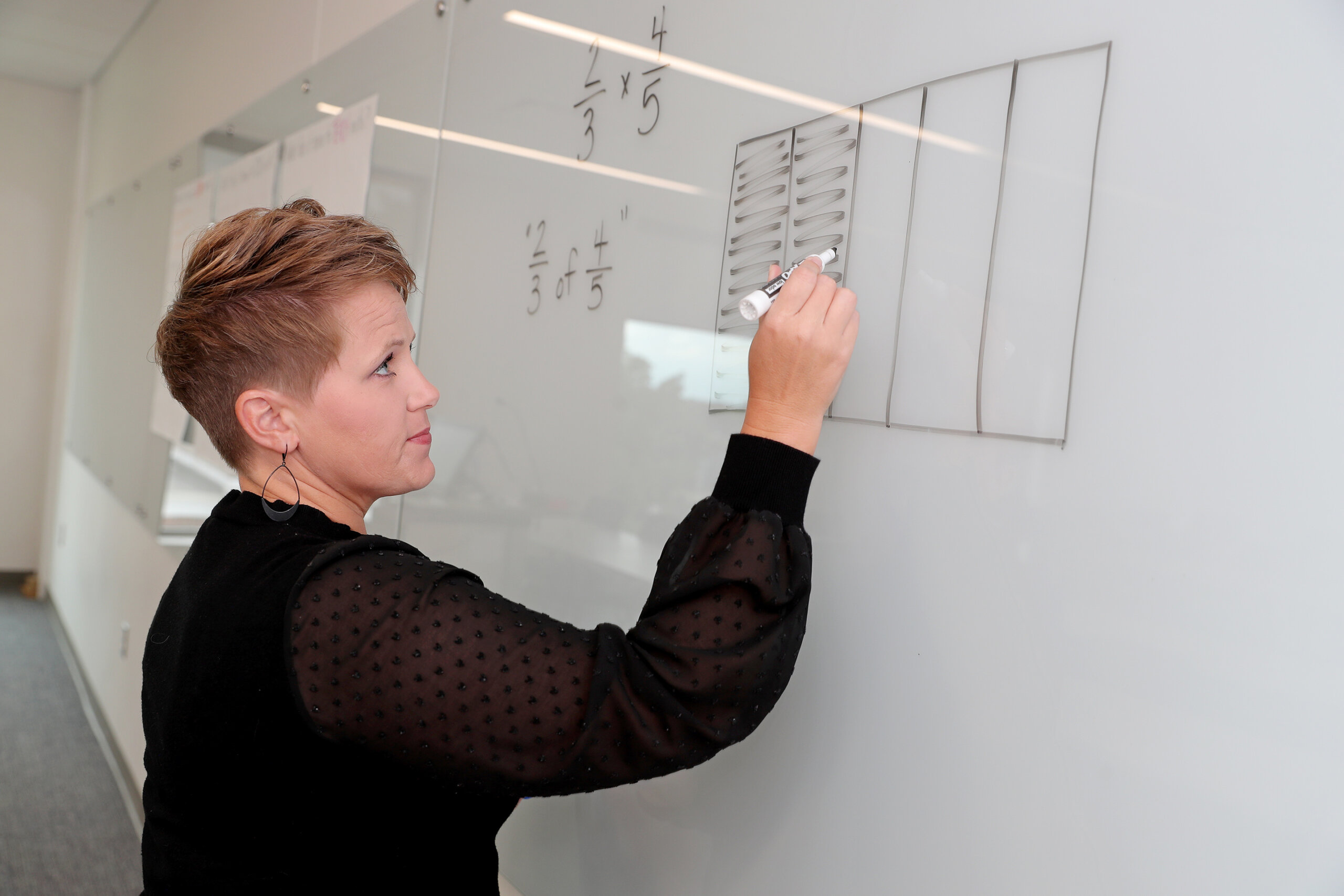
Intermediate Algebra, or Math 101, was expanded from three credit hours to four, giving students more time with faculty without adding more content. Instead, instructors focused the curriculum on concepts students need to master and incorporated research-based teaching strategies such as active and cooperative learning.
Students regularly work through problems together on whiteboards with instructors available to provide support, and faculty devote class time to developing skills such as effective study habits and time management.
Additionally, the department strengthened its partnership with the Loper Success Hub and UNK Tutoring and Academic Support. Tutors visit classes to introduce available services, and a pilot program places a tutor directly in Math 101 classrooms to assist students during activities. The department plans to expand that model to more sections.
These changes are part of a broader shift that began under former department chair Derek Boeckner and continues today.
“We believe that all students can learn challenging mathematics when we provide supportive conditions for learning,” Rupnow said. “The primary component in improving student success has been instructors who are dedicated to providing an environment where students can flourish and engaging students in ways that promote their success.”
That focus extends across the department. Faculty discuss teaching and student success during monthly meetings, review DFW data and collaborate on course content and instructional materials. The department recently hired a faculty member whose research focuses on undergraduate mathematics education and student success in general education courses.
The approach appears to be working.
Along with the decline in DFW rates, enrollment across the targeted first-year courses increased from 852 students in 2021-22 to 1,067 in 2024-25.
“These numbers show that more students may be taking courses here at UNK rather than taking their general education coursework at other institutions while enrolled at UNK and attests to the growing confidence in our department and our math instruction,” Gensler noted.
Building on success
The same collaborative approach that drove these improvements will guide the department’s next steps.
Faculty continue to revise introductory courses, collaborate on teaching strategies and pursue professional development focused on undergraduate mathematics education. Additional changes are planned for Mathematics for Liberal Arts, and faculty continue to evaluate placement methods to help students select courses that match their preparation and academic goals.
“This focus on student success has begun to change the culture around teaching and learning in our department,” Gensler said. “Faculty are purposeful about how they support students and intentional about improving their instruction. Because of the formal discussions about student success, many more informal discussions occur that impact the way we view our students, how we teach our classes and what we do to support students outside of the classroom.”
The $25,000 award will support that work. Plans include faculty professional development, curriculum and instructional material development, expanded peer tutoring and supplemental instruction and research focused on undergraduate mathematics education.
Those future initiatives build on the same student-focused philosophy that produced the department’s progress over the past five years.
“Our student-centered approach ensures strong learning outcomes that help students progress through the college experience and graduate on time,” Rupnow said. “We prepare future leaders to think analytically and serve throughout the state of Nebraska and beyond.”
Praise from campus partners
“The UNK Math Department has been a great partner over the past few years as Student Affairs tried to increase student success and retention on campus. The Math Department has been very open to hearing suggestions on how to support students and how we can partner to help students be successful. We’ve partnered in the past on a head-start program aimed at new first-gen and at-promise students. Their contributions and participation in the program helped students get started on a level playing field.” – George Holman, associate vice chancellor for student affairs
“UNK’s Department of Mathematics and Statistics has implemented significant change to advance student success. Responding to the increasing number of students entering college with limited mathematical preparation, the department systematically reevaluated campus needs, expanded course offerings and strengthened its curriculum to better support students at the outset of their academic careers. Notably, the Intermediate Algebra course was redesigned as a four-credit class with an additional weekly session to reinforce essential concepts. This enhanced structure provides students with a more robust mathematical foundation for subsequent coursework in mathematics, statistics, chemistry and physics. This support is especially critical for those pursuing healthcare pathways.” – Peggy Abels, director of UNK Health Sciences