THIS STORY IS FEATURED IN THE 2025 NEW FRONTIERS MAGAZINE
By TODD GOTTULA
UNK Communications
KEARNEY – In a quiet bedroom in Albuquerque, a young girl stood alone at the foot of her bed, arms open to an audience of dolls and stuffed animals.
She was no older than 4, already weaving stories into song – self-composed operas of wonder and make-believe. Her stage was a hardwood floor. The lone window let in little light.
That’s where it began for Sharon Campbell.
Before the degrees. Before the stage lights and students and opera houses. Before her name graced faculty rosters or recital programs. It began with toys for an audience – and no one telling her to stop.
“There was a certain imagination of there being an audience and there being a gaze on me,” she says now. “But mostly, I just wanted to story talk. I think I was born to tell stories through music.”
That imagined audience became real soon enough.
In first grade, at Holy Ghost School, it was her class’s turn to host Mass. As the students began to sing, every head turned. All eyes found her. She didn’t yet understand why. She just knew they were listening.
“From that moment on,” she says, “I was THE singer.”
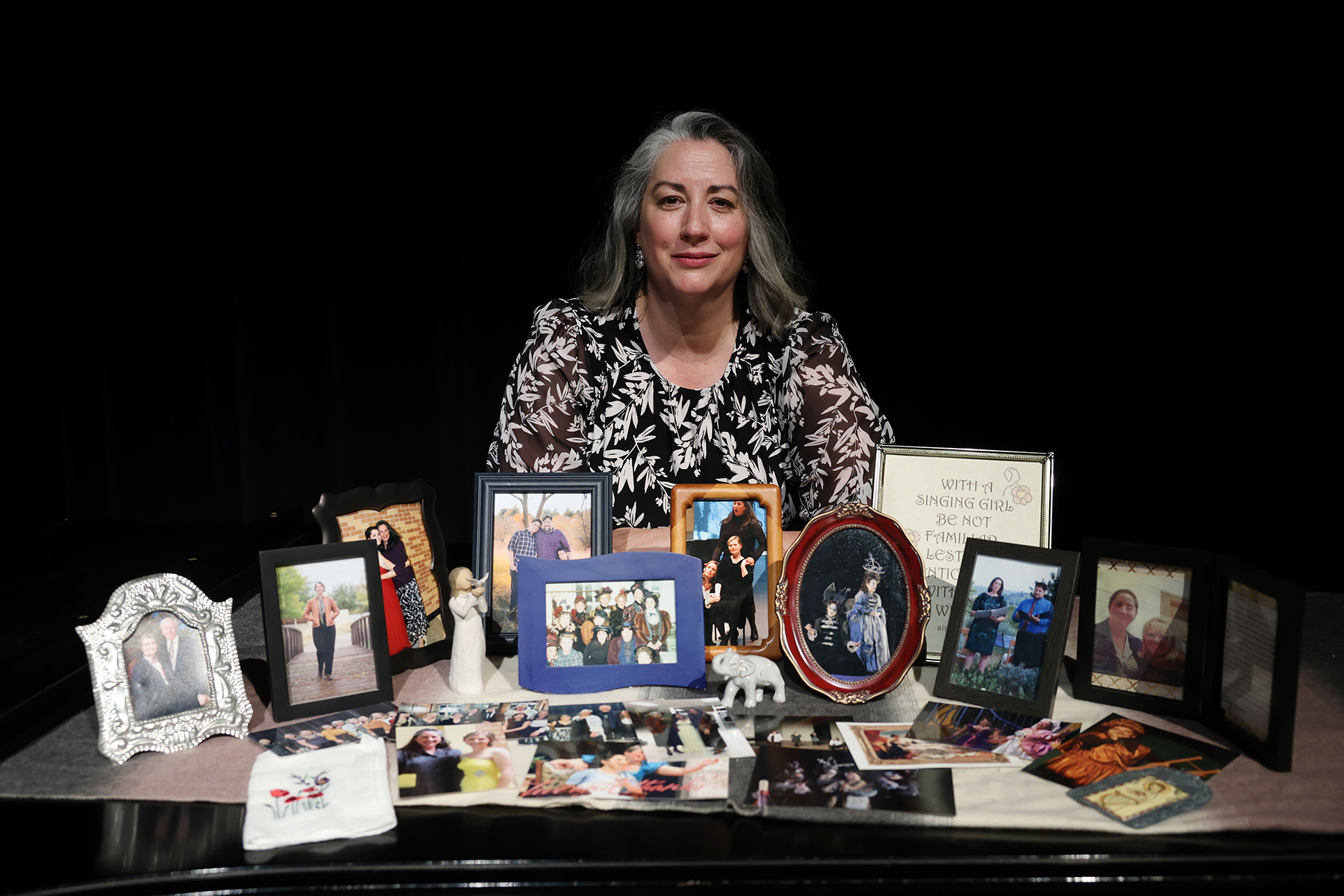
By 8 or 9, she was singing solo in church at the Christmas pageant – “Sleep, Baby, Sleep,” a lullaby for the infant Jesus. She stood at the lectern, framed by the orange and gold pendant that glowed on its front. Black skirt. White blouse. A red ribbon at her collar. Feathered hair. Four hundred filled the pews.
Her jaw tightened. Her voice shook a bit. But she sang.
“I remember the terror and nervousness,” she says. “Not being sure if I was in tune.”
Still, she kept singing.
The daughter of Libbie – a small-town Missourian who led Catholic Mass with a voice like a “female, velvety Mel Tormé” – Campbell was drawn to the liturgical and lyrical. She sang in church, joined community theater in high school and eventually pursued vocal performance in college.
Her first experience with opera wasn’t from a theater seat – it was from backstage.
“My freshman year we performed ‘Madame Butterfly,’ and the women’s chorus was asked to be the geisha chorus,” she says. “The first opera I ever saw, I was in. And I was hooked.”
And the hook held.
Her education took her from the University of New Mexico to the University of Missouri-Kansas City’s Conservatory of Music and then to the University of Kansas, where she earned her doctorate.
Now, 16 years into her career as professor of music and voice at the University of Nebraska at Kearney, her identity remains rooted.
“I identified as a singer very young – the one who sang solos – and I owned that identity,” she says. “That earnestness is something I’ve tried to protect.”
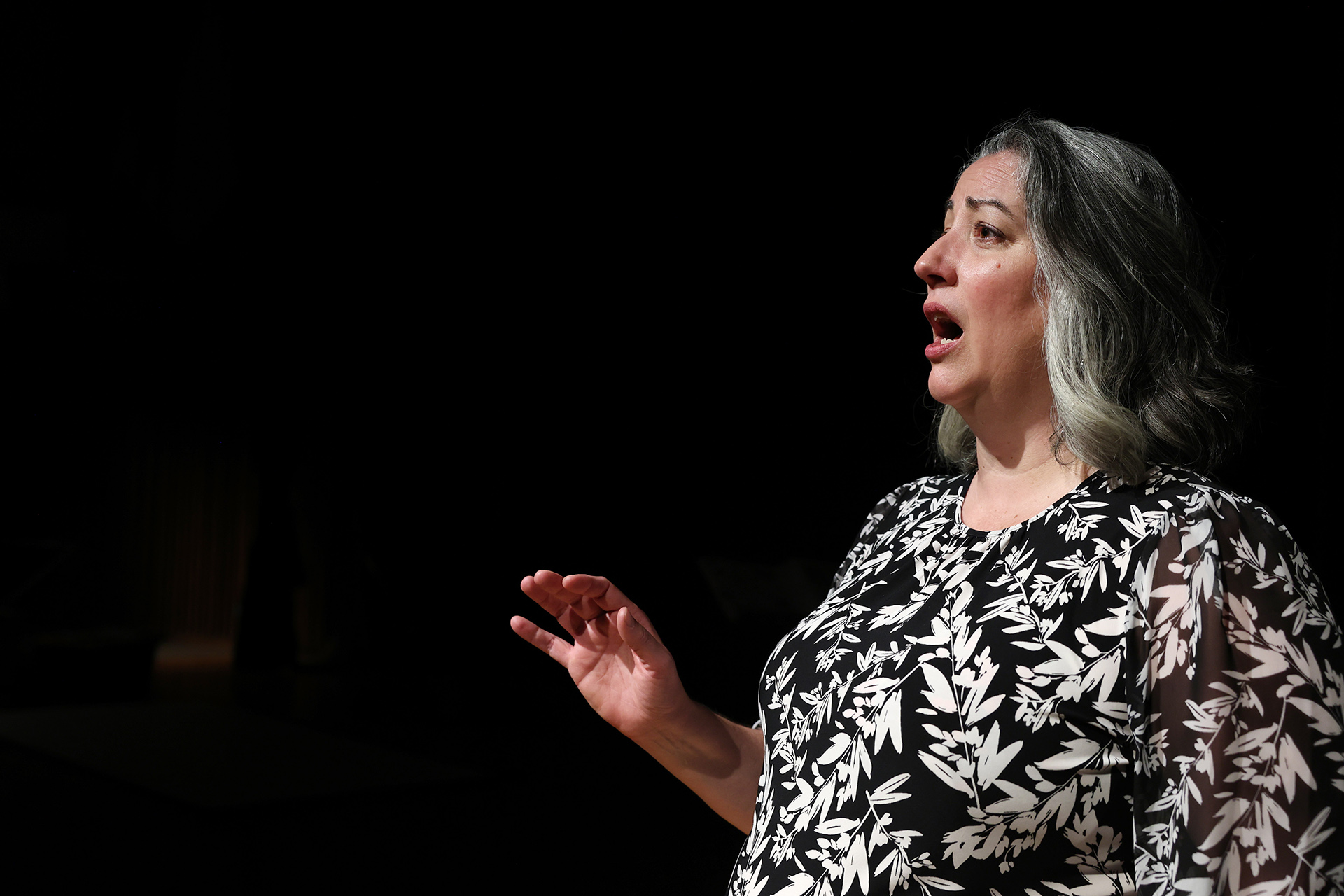
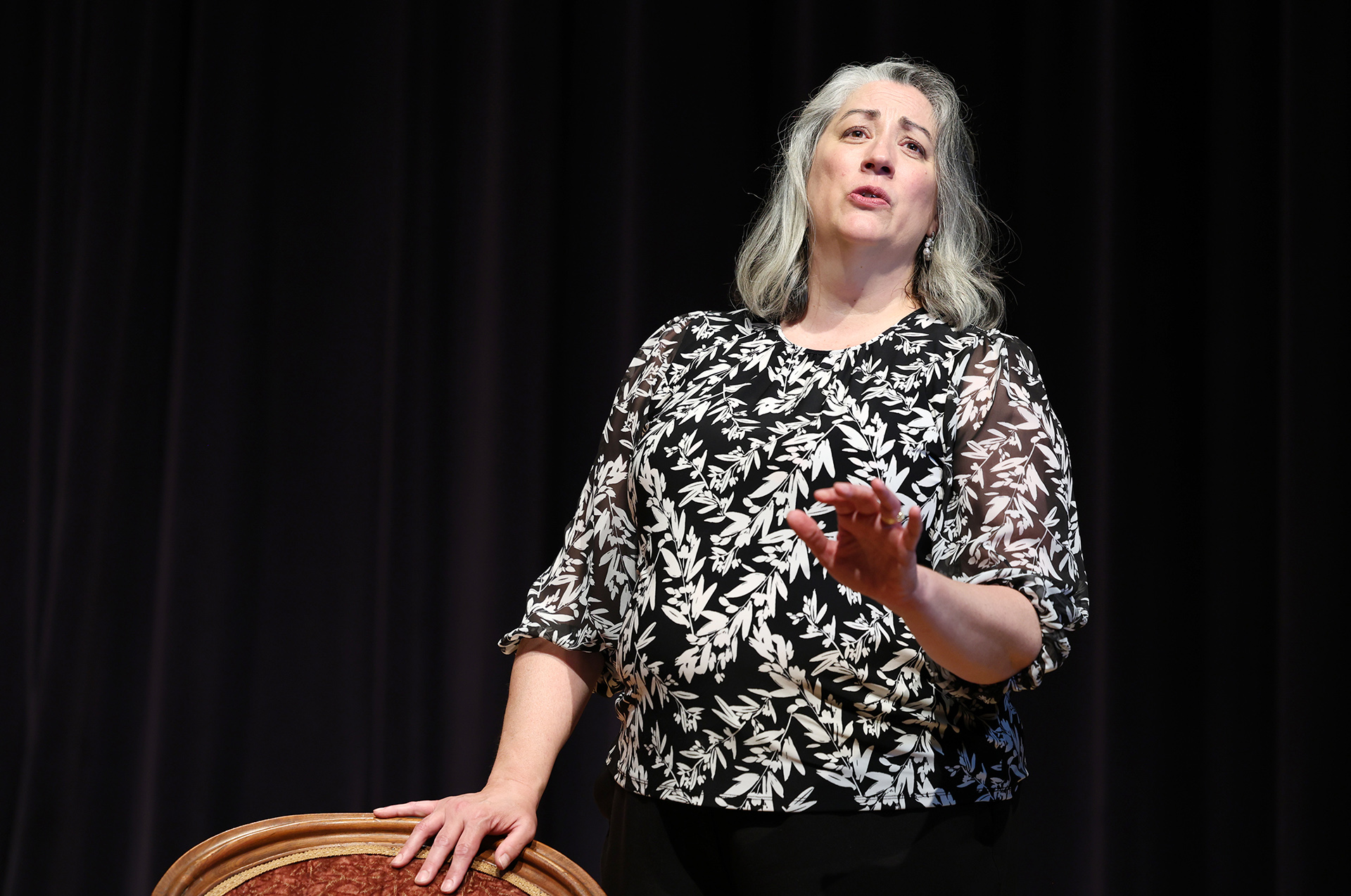
Even now, performing can feel surreal. She describes entering a kind of trance on stage. Some call it the zone.
“Sometimes I perform in what I call an indigo fog,” she says. “It’s like the air takes on a texture, like it’s smeared with Vaseline. There’s a cloudiness – and it takes on a blue tinge. When it’s really good, it’s blue.”
She still chases the blue.
She still sings.
She still believes in the sacredness of performance. Not for the attention, but the connection. Especially now, with her father gone and her mother watching recitals online from New Mexico.
“It’s not the same,” she says. “But it still matters.”
So, she protects that part of herself – the girl with the operas, the toys and the belief that stories are meant to be sung.
Because even now, after everything, that feeling returns.
And when it’s good – it’s blue.
STORIES TOLD IN SALT
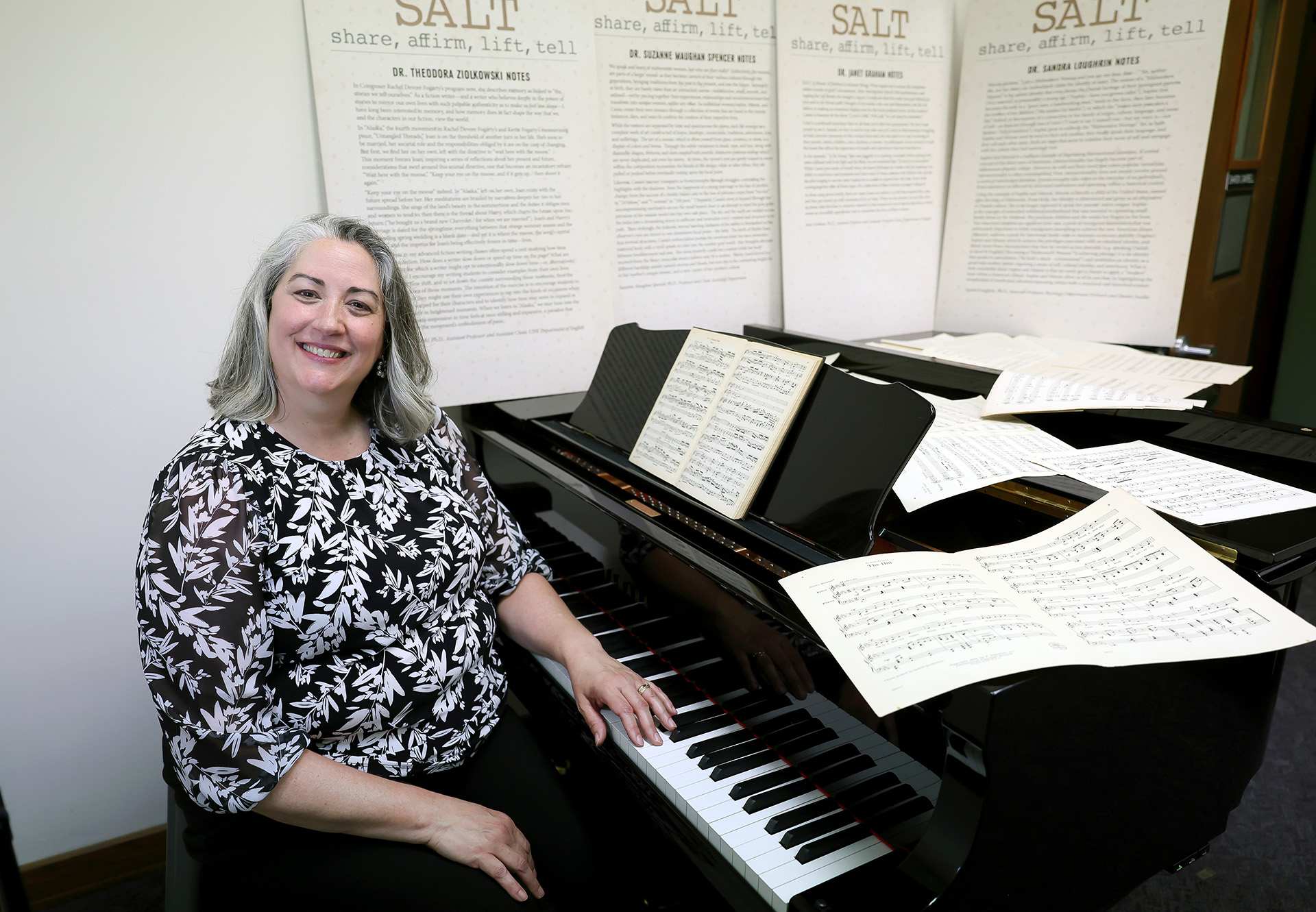
Not all stories are sung in sweeping acts or grand arias. Some arrive in flashes – moments distilled into 15-minute micro-operas. That’s the canvas of SALT, a quintet of music professors who tell stories of women’s history, resilience and legacy through song.
Campbell co-founded SALT – short for Share, Affirm, Lift, Tell – alongside University of Nebraska-Lincoln colleague Suna Gunther and others from Minnesota and New York. Their mission: to create and perform commissioned micro-operas that elevate the under-told personal histories of women, particularly in the Midwest.
“We were really motivated to tell different stories,” Campbell says. “We’re Midwestern women and wanted to share those roots – our mothers’ and grandmothers’ stories. How they endured day after day, being gritty and loving their kids.”
Their work is deeply personal. One commissioned piece draws from the life of Skidmore College faculty pianist Young Kim – her journey from South Korea to the U.S., the grief of losing her partner, and her strength as a mother.
“It’s just so clear and passionate and powerful,” Campbell says. “We believe these white Midwestern women’s experiences carry a kind of universality, and we overtly tied that to our own stories. You can see her pour everything into it.”
Audience reactions are often tearful, always heartfelt.
“We hear so many family stories afterward,” Campbell says. “It hits a nerve when someone says they see their grandmother in the stories we’re telling about ours.”
Now, Campbell hopes to expand SALT’s reach. She envisions building a modular repertoire of micro-operas, giving venues the flexibility to curate performances from a growing library. She also sees SALT evolving into a consulting group to help others commission similar works.
But at its core, SALT remains deeply personal. Because for Campbell and her colleagues, performance isn’t just an outlet – it’s a necessity.
“Performing is something that feeds us,” she says. “We chose this academic ladder. We’re not bouncing from one opera company to another, so we must create our own venues.”
And when those venues open, students walk through, too. Not just as spectators, but as collaborators.
“We bring students up to perform with us,” Campbell says. “It’s not just about teaching or directing. It’s about sharing the stage. Offering a different level of mentorship.”
Because today, stories aren’t just passed down. They’re handed over.
FUTURE OF FINE ARTS
Campbell doesn’t hesitate to name her fear. It’s not just the loss of music programs – it’s the fading of music as a way of life in the places that need it most.
“One of the things that feels like a vocation for me here is to support those backbone musicians in small towns,” she says. “We’re losing that.”
She sees it happening everywhere – fewer opportunities in rural schools, shrinking support on college campuses, an erosion of cultural value. And it breaks her heart.
“Not only is our culture not understanding and appreciating the arts as a body of work, but seeing that devaluation happen at the university level is brutal,” she says.
So, what’s the answer?
Better storytelling. Stronger advocacy. And yes – data.
“We must do a better job of communicating the economic impact of the arts on towns,” she says. “Uplift these values by asking what the arts give us economically.”
But numbers aren’t enough. Campbell believes we’re losing something deeper: an appreciation for the long, messy, beautiful process of making art.
“We’ve too often relied on the unspoken – assuming people just understand that live music is something special,” she says. “But it takes effort.”
And heartbreak. And time. And blue-tinted fogs.
“You know the old joke: ‘How do you get to Carnegie Hall? Practice, practice, practice,’” Campbell says. “But in a culture chasing instant success, we’ve lost sight of the process – the years of behind-the-scenes work that make it all possible.”
That’s what she hopes her students take with them – not just technique, but devotion. Not just sound, but substance. The understanding that artistry isn’t something you have. It’s something you earn, protect and grow.
“People think creativity and artistry are things you either have or don’t,” she says. “But I want them to understand – it’s seasoning. It’s preserving. It’s something you pursue for the long haul.”
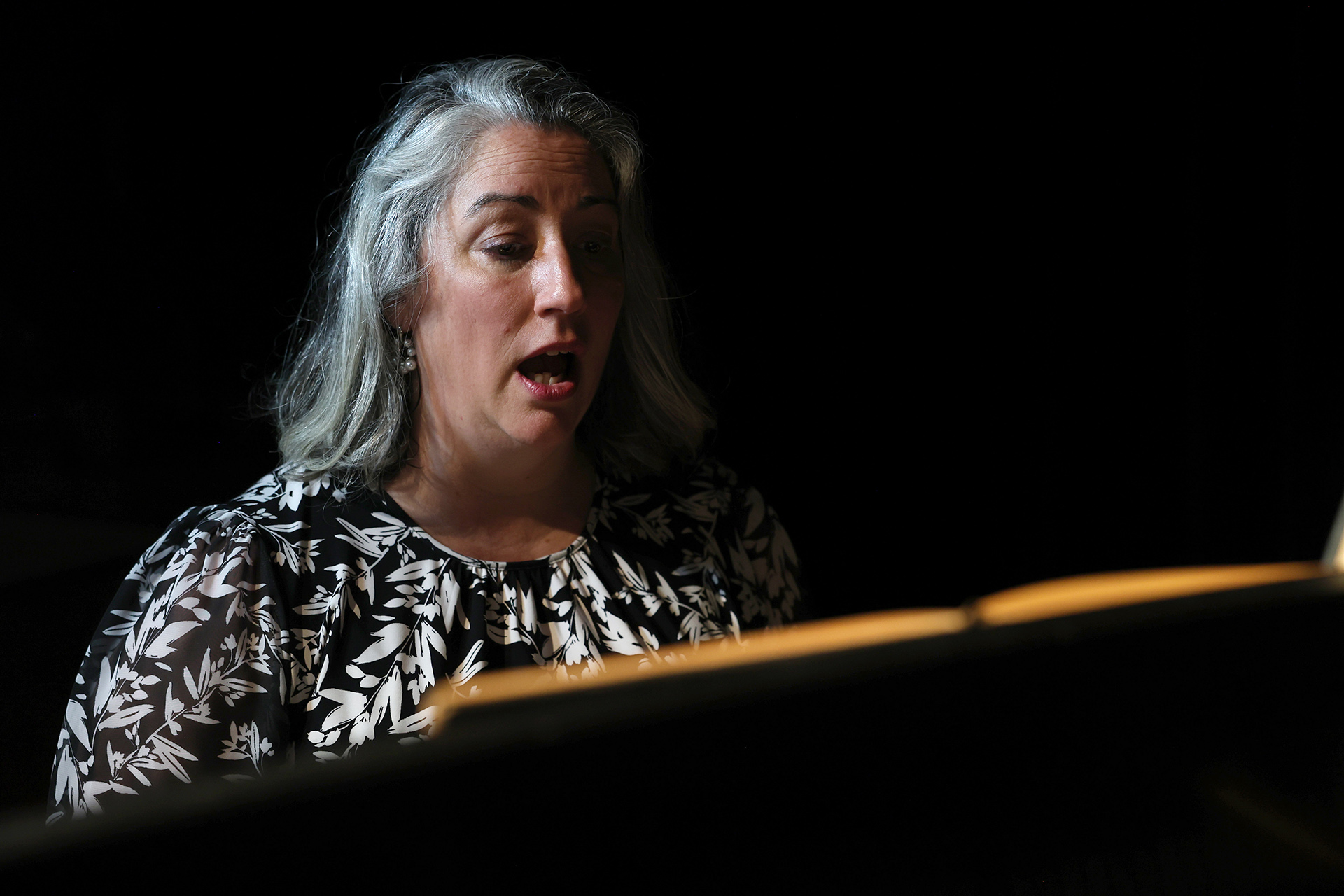
BUILDING VOICES, NOT JUST TEACHING THEM
Campbell is at home in the classroom. But her classroom isn’t limited to practice rooms or music halls. It’s anywhere breath becomes sound. Anywhere a student is brave enough to be heard.
“I love voices,” she says. “Sometimes I visit a high school and it’s like discovering pirate treasure. We’re all these rough diamonds. I love helping someone uncover the true beauty of their voice and seeing their reaction.”
She’s not chasing perfection – not for herself, and not for her students. A strong performance doesn’t always mean hitting every note. It means resonance with the self, the audience and the silence that follows.
“We always strive to find our personal 10. But in performance, if you can hit an eight, you’re doing great,” she says. “Sometimes it’s just the audience reaction. Sometimes it’s the silence afterward. That feels like success.”
Her own performances are foundational to how she teaches. Whatever she’s working on as an artist shows up in her classroom or studio.
“If I’m working through a technique, my students hear about it,” she says. “Whatever I discover as a performer comes into their lessons.”
What she hopes they carry forward is a sense of autonomy – something she had to learn the hard way.
“I was someone who, all through my master’s degree, did what I was taught,” she says. “But during my doctorate, I had to start owning my choices. Teaching myself. Learning to love myself as an artist who continues to learn. That’s been powerful.”
That’s why she brings students on stage with her. They don’t just watch – they participate. They see her take direction. They see her vulnerable, interpretive, intentional.
“There were times when I got to be on stage with a faculty member,” she recalls. “Seeing those people who were always giving me direction – and how they took direction – was such an important lesson in professionalism. That’s what I want to model.”
For Campbell, collaboration isn’t delegation. It’s a shared investment. A high-stakes, high-reward exchange of artistic trust.
“Collaboration is about building,” she says. “And it takes time. But it’s worth it – in how it ends, and in the impact it leaves behind.”
PHOTOS BY ERIKA PRITCHARD, UNK COMMUNICATIONS

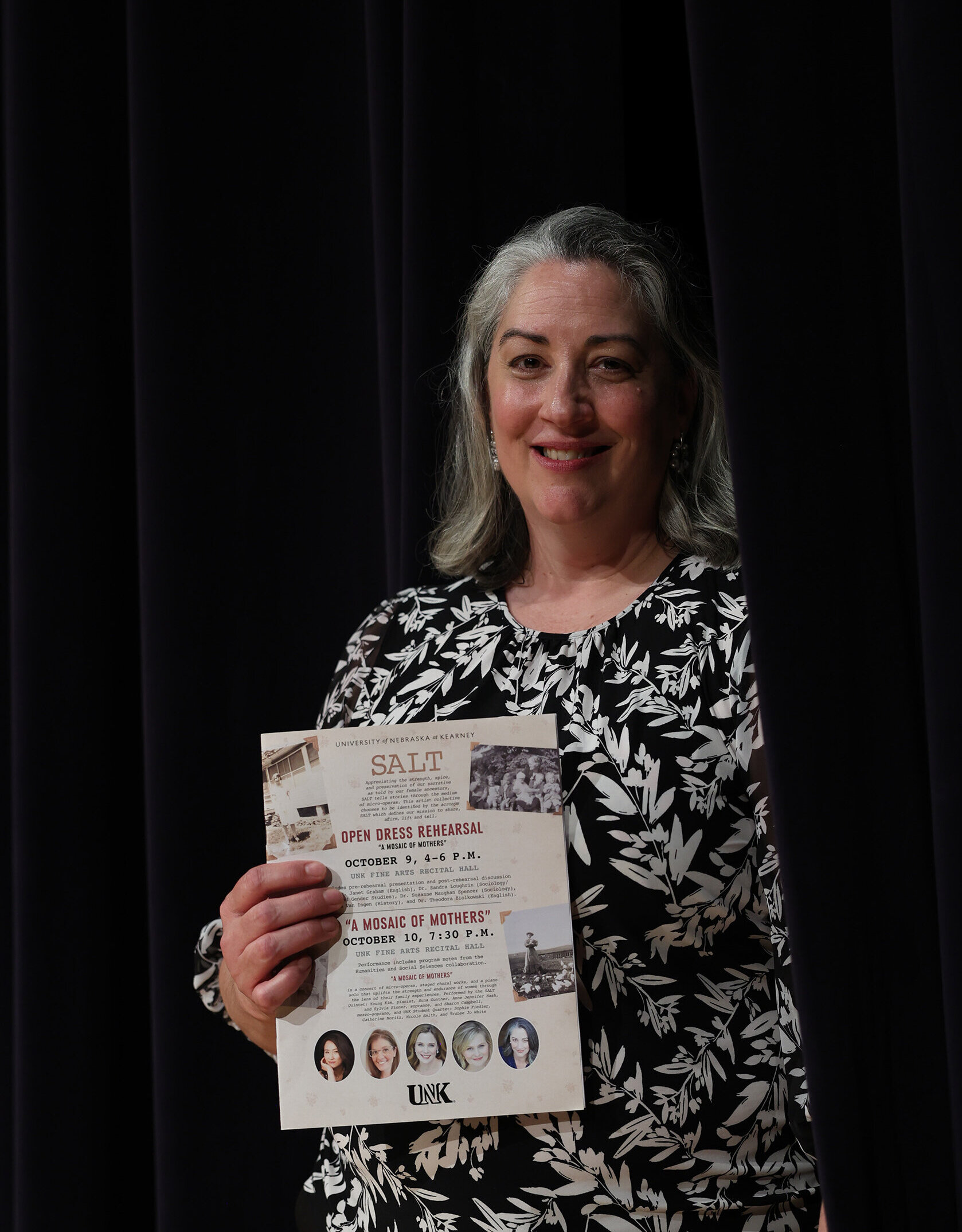
SHARON CAMPBELL
Title: Professor of music and voice
College: Arts and Sciences
Education: Doctor of Musical Arts in vocal performance, The University of Kansas, 2008; Master of Music in vocal performance, Conservatory of Music, University of Missouri-Kansas City, 2000; Bachelor of Music in vocal performance, The University of New Mexico, 1997.
Years at UNK: 16
Performance Specialization: A mezzo-soprano, Campbell is known for her work in contemporary music, frequently premiering new compositions. As co-founder of the SALT quintet, she has co-commissioned micro-operas and helped create the innovative concert “Mosaic of Mothers,” performed across the U.S. She also secured Humanities Nebraska funding to support a SALT residency at UNK.
Campbell is equally at home in opera, concert and recital settings. She has appeared as soloist in Bach’s “St. Matthew Passion,” Beethoven’s “Mass in C” and “Symphony No. 9,” and Handel’s “Messiah.” Her operatic roles include the Third Lady in “Die Zauberflöte,” Baba in “The Medium,” La Badessa in “Suor Angelica,” The Princess in “Sister Angelica, Florence Pike in “Albert Herring,” Mistress Quickly in “Falstaff,” the Witch in “Hansel and Gretel,” Mme. Du Croissy in “Dialogues of the Carmelites” and Terentia in UNK’s award-winning production of “Captain Lovelock.”
Courses Taught: Voice Lessons, Voice Techniques, Vocal Pedagogy, Sight-Singing and Ear Training I, Secondary Choral Methods, The Visible Voice, The Art of Practice, Introduction to Musical Theatre.
Co-commissioner/Performer – “A Mosaic of Mothers”
- SALT Quintet concert of micro-operas, featuring piano solo and staged choral work:
- University of Nebraska- Lincoln (2023)
- Helen Filene Ladd Concert Hall, Skidmore College, Saratoga Springs, New York (2023)
- University of Nebraska at Kearney (2024)
- Kansas City Public Library, Kansas City, Missouri (2025)
- No Limits Conference, Kearney (anticipated, March 2026)
Co-presenter/Performer – “Sprinkling SALT: Using Micro-operas to Connect Communities and Awaken Her-story”
- College Music Society National Conference, Spokane, Washington (Oct. 30 to Nov. 1, 2025)