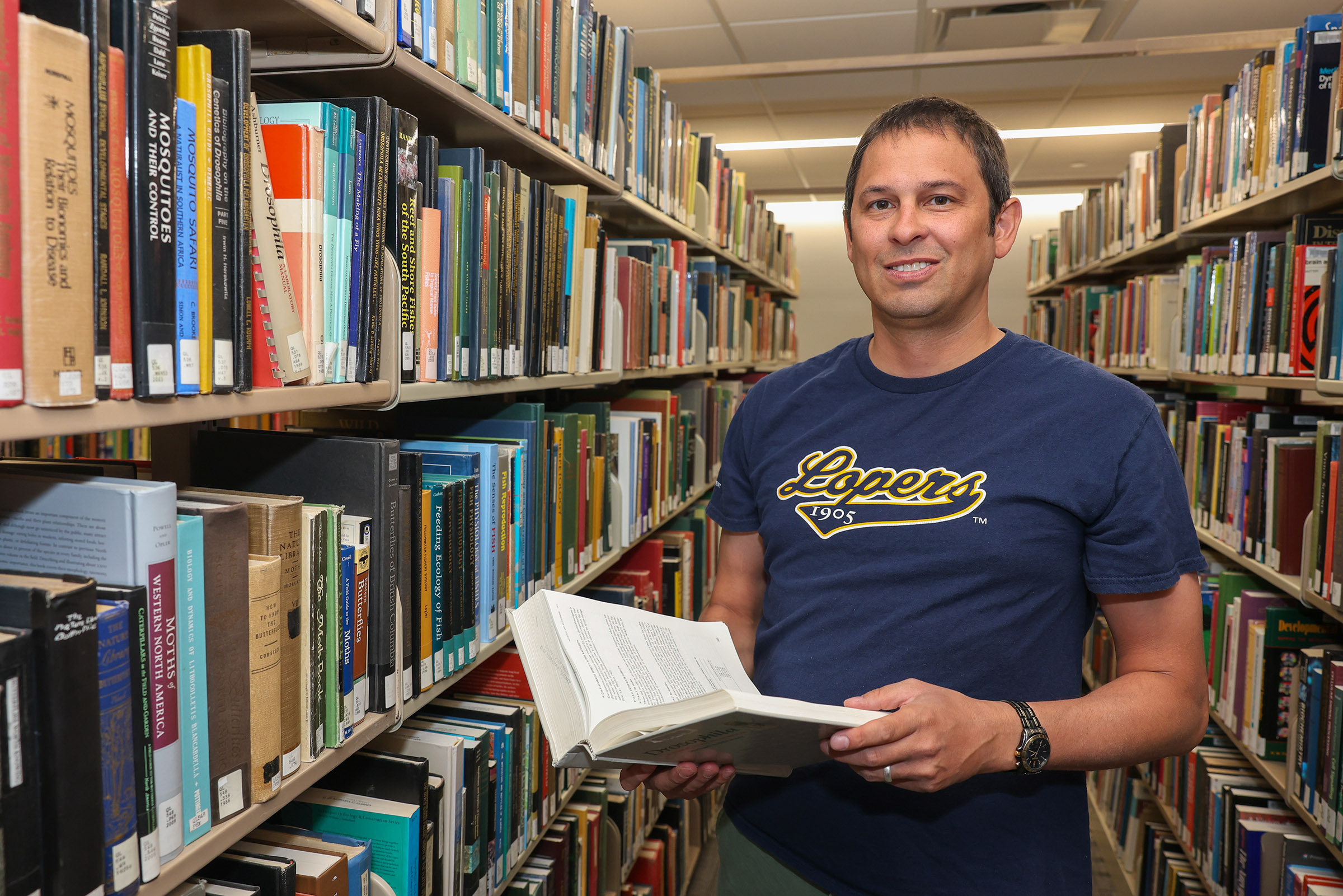
David Arredondo’s journey through the University of Nebraska System began more than a decade ago, not in a library, but in dining services.
He started his first job with the NU System in 2012, shortly after meeting his wife during their freshman year in Neihardt Hall at the University of Nebraska-Lincoln. Since then, he has steadily worked his way up through the system, moving from roles in acquisitions at UNL Libraries to his current position as collection services librarian and associate professor at the University of Nebraska at Kearney, where he’s worked since 2018.
“My roots with the university run pretty deep,” he said.
Arredondo earned a bachelor’s degree in English literature from UNL and later a master’s in library and information science from the University of Missouri-Columbia. After exploring several academic disciplines as an undergraduate, he found librarianship to be the ideal fit – a career that placed him at the center of knowledge, with the freedom to explore diverse fields.
At UNK, his work continues to evolve, recently expanding into artificial intelligence, which reflects his ongoing commitment to making information more accessible, efficient and meaningful. Through campus training sessions, committee work and student mentorship, Arredondo is helping the UNK community navigate the rapidly changing landscape of digital research and data-driven tools.
Tell us about your role as collection services librarian:
I supervise the collection services unit in the library, where we handle all the acquisitions and cataloging of library resources like books and databases. I supervise up to four full-time staff, and there are five of us currently in collection services. So, for example, when the library was being renovated and we needed to reduce the overall footprint of the book collection, I was responsible for leading that.
I also do some class instruction, though not as much as some of my colleagues in the library. I really enjoy teaching research methods courses. When students see a tool like Zotero and how it can help them manage their resources for a paper and their citations, they get really excited.
What does cataloging look like in a modern library?
Some of it is like what you would expect – reviewing a physical book to assign metadata to make sure people who might be searching for that type of information online can find it. Also, catalogers are a very active and collaborative community. Increasingly, that means many libraries are focusing more energy on original cataloging of unique materials in their collections.

Tell us about your research:
My primary research is in the application of business analytics and business intelligence in academic libraries. Libraries are data-rich organizations, and while we do use that data to inform our decisions, I believe applying business analytics and business intelligence strategies will make us much more effective and transparent stewards of that data.
A secondary path is the application of natural language processing (NLP) to study books that promote conspiracy theories. I don’t always make as much time for this as I’d like, but it has led to mentoring Undergraduate Research Fellows, which has been hands-down my favorite part of any of the work I’ve done at UNK.
What inspired you to take a lead role in AI training on campus?
I was exposed to large language models (LLM) while applying natural language processing, computer-assisted processing and analysis of natural language, to my research. This was shortly before the commercial release of ChatGPT. I did a lot of training, especially through Constellate, which explained how models are developed, how they can be applied and where they excel or fall short. Then, starting in 2024, I’ve served on several AI committees, which forced me to take a more nontechnical perspective on AI.
I hope the sessions help people understand LLMs and AI better so they can separate the hype from truth.
How do LLMs and AI assist university employees in their work?
This is something that is developing right now. UNK has ChatGPT Enterprise licenses available that we started distributing during the spring. With these licenses, employees and students can interact with information in a very different way than ever before. During the fall, we’ll establish learning communities to share best practices and learn from one another.
A personal example I can share is using it to store meeting notes, documents and other information related to a topic, like my work in collection development. I can then interact with that information in a conversational way and have the LLM cite back to specific documents where it is finding information.
What do you enjoy most about your job?
Without a doubt, getting to know and work with students. I think a smaller portion of what I do involves students compared to many of my colleagues, so I really cherish those opportunities.
Share something unique about yourself:
I grew up a classically trained violinist and my three kids all play violin, too – on the same violins I played growing up.
