THIS STORY IS FEATURED IN THE 2026 NEW FRONTIERS MAGAZINE
By TODD GOTTULA
UNK Communications
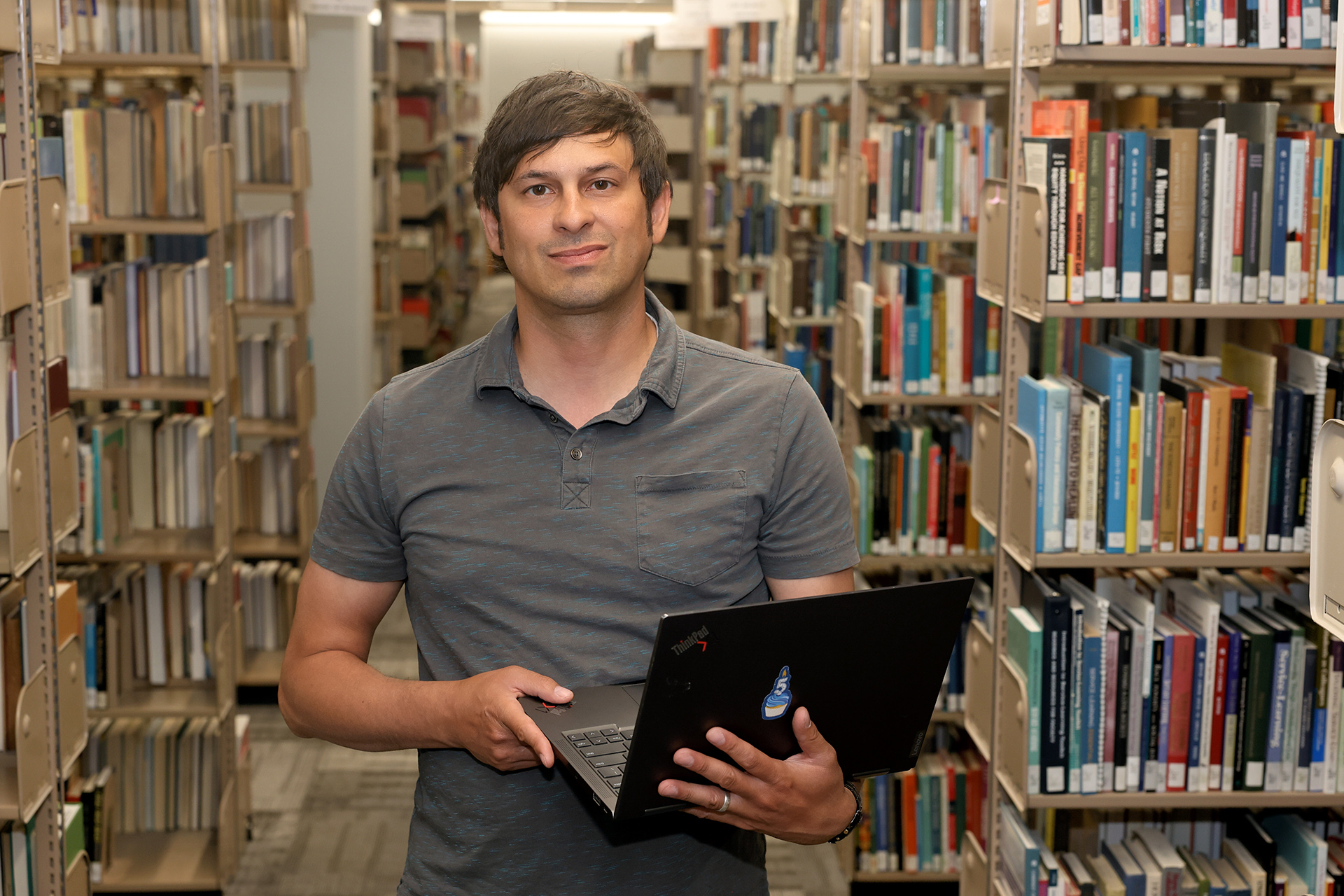
KEARNEY – David Arredondo doesn’t fit many people’s image of a librarian.
At 39, he looks more like an indie rocker. With tousled dark hair, jeans, a T-shirt and old-school sneakers, he carries the easygoing vibe of a musician, not the stereotype of someone who spends their days shelving books in a quiet reading room.
In some ways, that’s fitting.
Long before he was studying artificial intelligence, analyzing data or helping libraries make better decisions, Arredondo was learning to play the violin. He started around age 4 and continued through high school, later adding guitar and bass while attending college.
That early experience left an impression that still shapes how he thinks today.
“I think it’s always in the back of my mind, the way you approach playing music together,” he said. “Playing off the other parts, finding where you fit, and not overplaying or underplaying.”
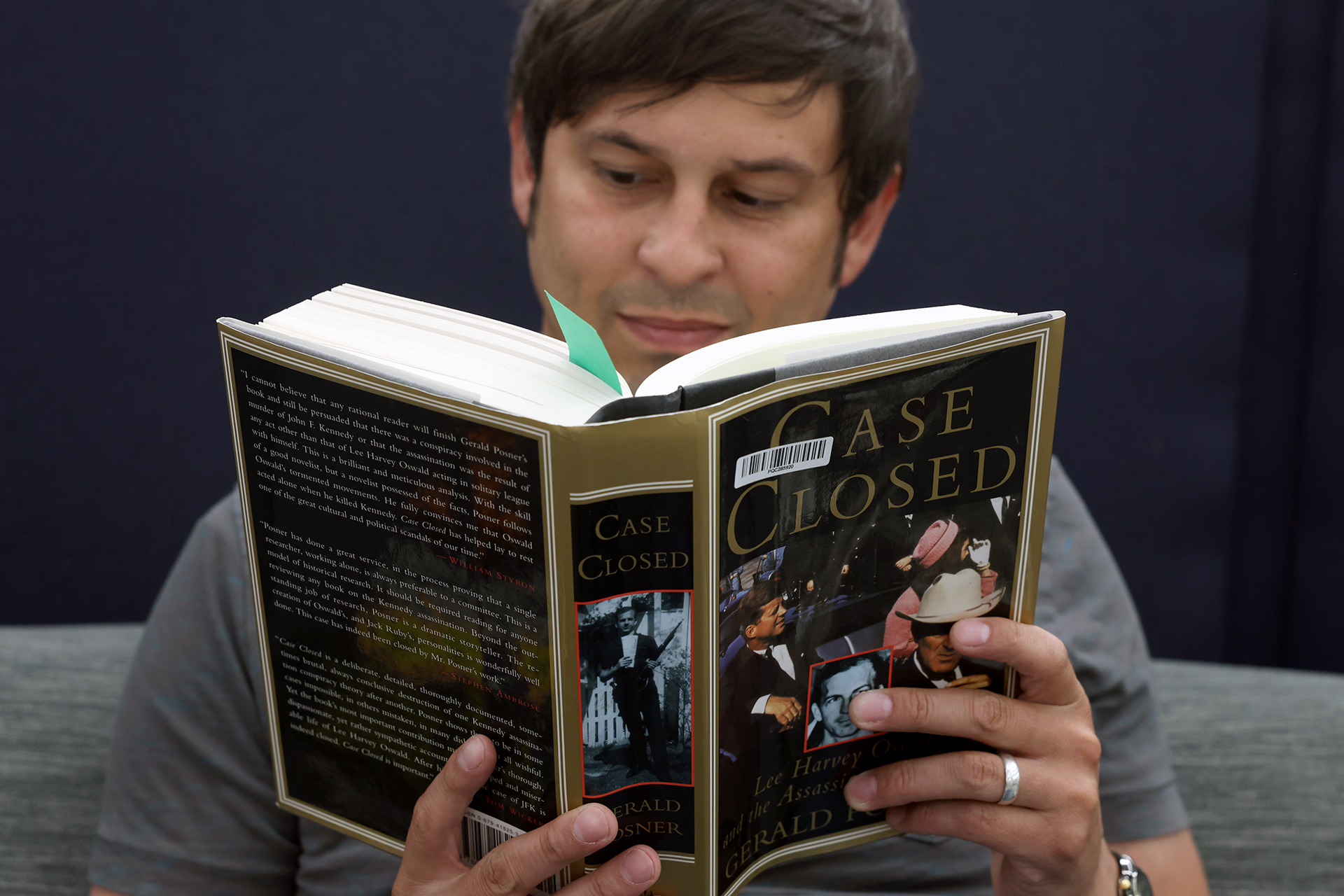
Spend a few minutes with Arredondo and the conversation quickly moves from music to artificial intelligence, digital humanities, enterprise data systems and student research. One moment he’s discussing conspiracy theory literature and the Warren Commission report on President John F. Kennedy’s assassination. The next, he’s explaining how libraries can better use data or how AI might be applied in thoughtful, human-centered ways.
The University of Nebraska at Kearney collection services librarian has built a career around technology, information and human curiosity.
Yet the thread connecting all of it isn’t technology.
It’s curiosity.
“As I was finishing my undergraduate thinking about what came next, in my mind was, well, if I go into working in an academic library, whatever I get curious about, I’ll be able to know where to find that information,” Arredondo said.
That simple idea helped shape a career that has taken him from library collections and acquisitions work at the University of Nebraska-Lincoln to research spanning enterprise data strategy, digital humanities and artificial intelligence at UNK.
“Just that curiosity, just being in a place where I can explore that when I have the opportunity,” he said. “That’s really what drove me into libraries.”
FINDING THE RIGHT SHELF
Arredondo’s path to librarianship was anything but direct.
Born in Ohio, he spent portions of his childhood in Buffalo, New York, and Texas before eventually finding his way to Nebraska. He attended a small private high school in Amarillo and grew up immersed in music.
Academically, he was harder to pin down.
“I had a really hard time as an undergraduate, just picking a path toward a degree and sticking with it,” he said. “I spent some time early thinking I was going to do pre-med or something like that. I switched and thought I’d do journalism. And then I switched and thought I’d do business, accounting, hospitality management. I finally ended up coming back and being an English literature major.”
Looking back, that winding path makes sense.
Arredondo wasn’t searching for a specific profession. He was searching for a place where intellectual curiosity could thrive.
“I always thought libraries looked interesting, particularly academic libraries,” he said.
While many people still associate librarianship with bookshelves and reference desks, Arredondo saw something different. He saw a profession built around information, discovery and learning.
“I really like the theory and practice of different disciplines,” he said. “That’s the kind of information that really is interesting to me.”
After earning his master’s degree in library and information science, he joined UNL in 2013 as an acquisitions associate and eventually rose to acquisitions manager. When the opportunity at UNK emerged, it felt like a natural fit.
“Looking at the job description, I was like, okay, I feel like this is written for me,” he said. “This really aligns with my experience and where I kind of see myself going.”
The move to Kearney and UNK proved to be the right one for Arredondo, his wife, Breinn, and their family.
“It was a nice match,” he said. “We kind of took the leap and it turned out being really nice for the whole family.”
MORE THAN BOOKS
Ask Arredondo what people misunderstand about librarians, and he’ll quickly point out that modern librarianship extends far beyond what many people imagine.
“I think the thing that people miss about librarians sometimes is that there’s a lot of different kinds of librarians,” he said.
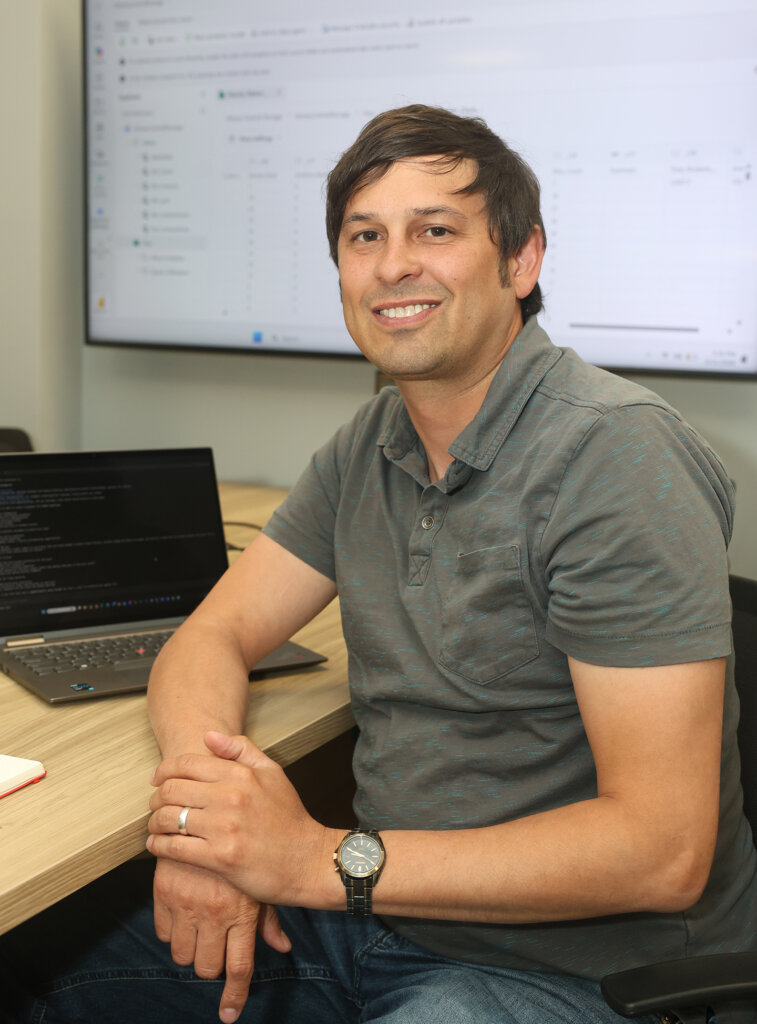 Today’s libraries include specialists focused on research data services, copyright, archives, digital scholarship and emerging technologies. Arredondo’s own work centers largely on collections, data and decision-making.
At the heart of much of his research is a simple observation.
“Libraries are data rich, but sometimes information poor,” he said.
Libraries collect enormous amounts of information about resources, usage, services and operations. The challenge is turning that information into meaningful insights.
“And so how do we better utilize data to support our decision-making to adjust our services?” he said.
That question has become one of the defining themes of his scholarly work.
Arredondo studies how enterprise data strategies can help libraries better understand their operations and make more informed decisions. The work helps libraries move beyond collecting information and toward using it more effectively.
“I hope I’m helping other librarians better understand the theories, strategies and practical tools they can apply in their own libraries,” he said.
WHERE HUMANITIES MEETS TECHNOLOGY
Although his current work often involves data systems, programming and artificial intelligence, Arredondo didn’t arrive there through a traditional technology pathway.
Instead, he came through the humanities.
Over the past several years, he developed a growing interest in digital humanities and natural language processing, using computers to analyze and interpret large collections of text.
“I was exploring more deeply natural language processing,” he said. “And that’s essentially using computers to help with analyzing texts or corpus of texts.”
One project focused on conspiracy theory literature. After receiving a small grant in 2022, Arredondo began using computational text analysis to study books promoting various conspiracy theories.
“I noticed nobody was applying the same computer-based techniques to studying books, or long-form texts, that promote conspiracy theories,” he said. “So, I thought that would be an interesting area to go in.”
To support that work, he began teaching himself programming.
“I was learning to write Python code for that starting in around 2021-22,” he said. “So just before ChatGPT even came out.”
That timing would prove significant.
When generative AI burst into public consciousness, Arredondo wasn’t immediately swept up in the excitement.
Instead, he approached it cautiously.
“When I started really more intentionally getting into working with AI, I told myself I was going to try to remain as ambivalent as possible,” he said.
His reasoning was straightforward.
“There is a lot of hype and there are a lot of concerns that are very real, but I think there’s also a lot of potential benefits that it’s hard to suss out from the dialogue happening around it.”
That balanced perspective continues to shape his work.
Rather than promoting AI adoption at all costs, Arredondo focuses on developing systems that are intentional, transparent and tailored to specific needs.
“We have to acknowledge that those concerns are real and not try to tell people that they shouldn’t have those concerns,” he said. “I don’t see my role as being one of trying to convince people that they need to use AI.”
STUDENTS AT THE CENTER
For all the discussions about technology, data and research, Arredondo repeatedly returns to one topic: students.
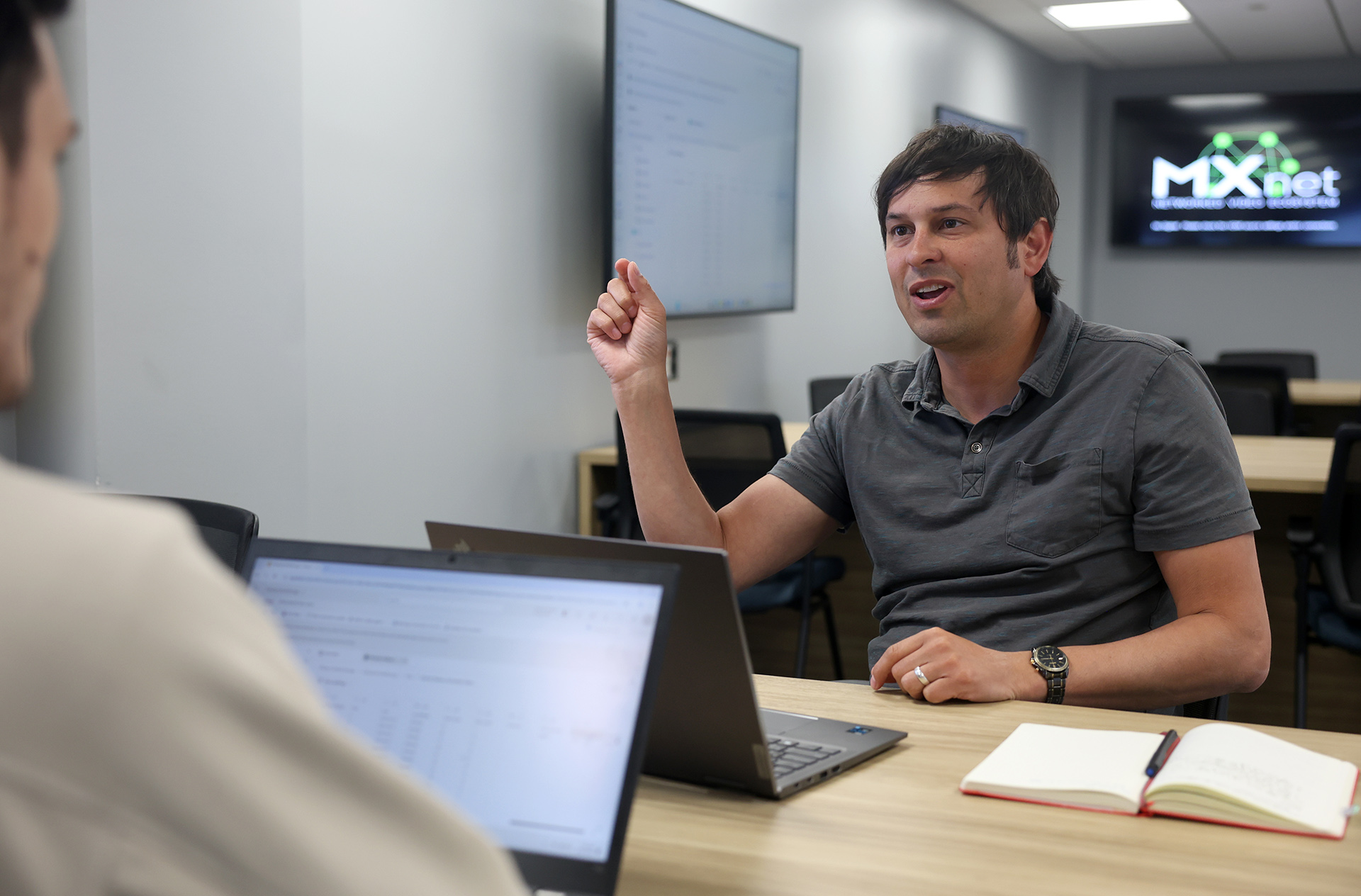
Whether working alongside graduate student Daler Rahimov on enterprise data systems and AI applications or mentoring undergraduate researchers, he sees student collaboration as one of the most rewarding parts of his job.
“I think that’s really where a lot of the energy to keep going in this work comes from,” he said.
One recent project involved undergraduate researcher Emma Huggins, who worked with Arredondo to analyze the Warren Commission report.
Using text analysis techniques, they created networks linking individuals mentioned throughout the report and explored how those connections shaped the narrative.
Other projects have examined newly released historical documents and the language used in conspiracy theory literature.
The specific topics vary widely. The process remains consistent.
Students are encouraged to ask questions, explore ideas and tackle problems that don’t have easy answers.
“Being able to work with students in more of a research capacity is fun because you get to see their imagination come through,” Arredondo said. “You really collaborate with them and watch them grow and develop along the way.”
SEEING HOW THINGS FIT TOGETHER
Today, Arredondo is exploring new ideas involving shared AI infrastructures and the ways knowledge can be shared across people, tools and systems.
He imagines a future where organizations, including small Nebraska businesses, can build AI tools tailored to their own needs and values.
“If I’m just dreaming and imagining, without having a clear concept of how we get there, I think of small Nebraska businesses,” he said. “A small team working in a shared environment with some shared information.”
Rather than relying on one-size-fits-all systems, Arredondo envisions AI that is integrated into an organization’s own operations, accessing only the information users choose to share and operating within boundaries they establish.
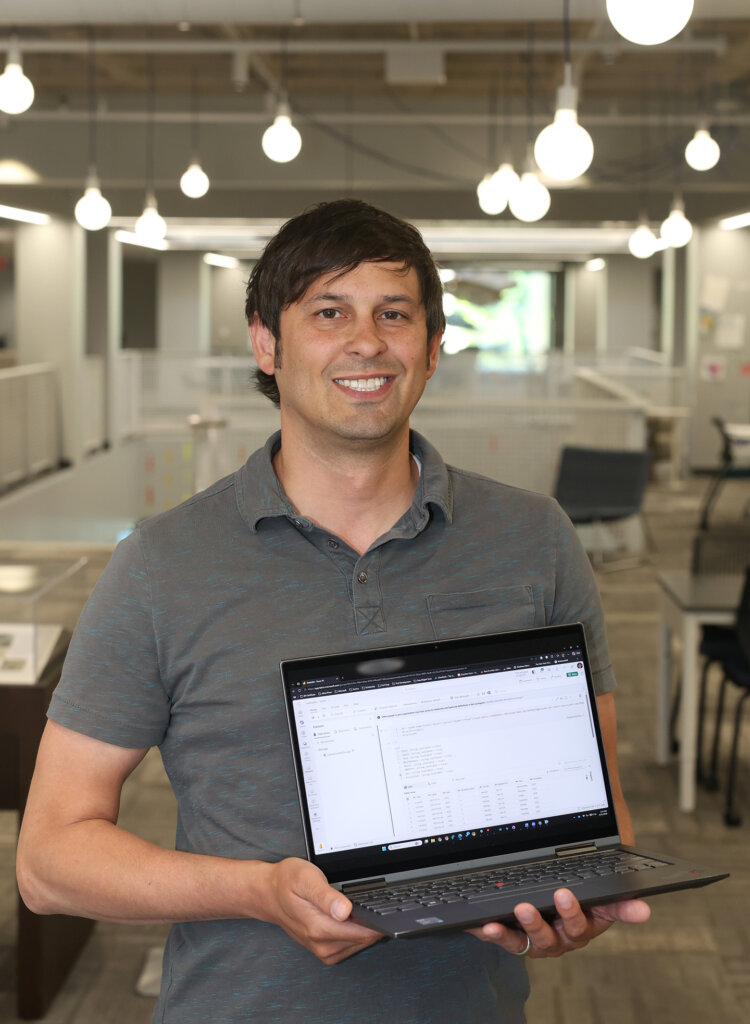 “How that could break down some of the barriers where if I know something, how do you have access to that knowledge without directly coming and talking to me?” he said.
He believes that approach could help address concerns about privacy, cost and control while making knowledge more accessible within organizations.
The work is still evolving, but the underlying idea feels familiar.
It echoes the same instincts that first drew him to music, then libraries, then research.
Arredondo sees common threads running through each stage of his life.
“I think, maybe on a subconscious level, it’s about seeing how things fit together, how different parts connect and how you adapt one side to accommodate another, and vice versa.”
For a librarian who studies data, technology, information systems and human collaboration, it is a fitting description.
And perhaps the simplest explanation for a career built on curiosity.
“Just being curious,” Arredondo said, “to explore and learn more.”
Along the way, he’s become part librarian, part researcher, part data analyst and part teacher.
But ask him how he sees himself, and the answer comes quickly.
“I 100%, through and through, consider myself a librarian,” he said.
DAVID ARREDONDO
Title: Collection Services Librarian
Department: Calvin T. Ryan Library
Education: Bachelor of Arts in English literature, University of Nebraska-Lincoln, 2010; Master of Library and Information Science, University of Missouri, 2013.
Years at UNK: 8
Areas of research/specialization: Arredondo’s research focuses on the application of enterprise data strategy in academic libraries and the digital humanities. His work examines how library data — including circulation counts, usage statistics and bibliographic data — can be analyzed holistically to support decision-making and improve systems and reporting. His interests in digital humanities and natural language processing led to a growing focus on large language models and artificial intelligence. Combined with his experience in embedded library instruction, this work has supported the development of AI literacy programming for UNK faculty, staff, students and the broader community.
Courses Taught: Research methods instruction in social work and kinesiology and sport sciences courses; guest lectures in chemistry seminars focused on artificial intelligence; AI literacy instruction for UNK faculty and staff.
Recent Published Articles: “Library Data as Enterprise Data,” NASIG Proceedings 40, in press; “Microsoft Power BI for Technical Services and Collection Development Reporting,” TCB: Technical Services in Religion & Theology, 2024; “Moving Beyond the One-Shot Instruction Session,” Brick & Click Conference Proceedings, 2022.
Presentations and Digital Projects: “Conspiracy Theories, Digital Humanities, and Undergraduate Research,” Nebraska Library Association College & University Section Spring Meeting, 2025; Organizer and presenter for the UNK AI Lightning Learn Series, 2025; “MLK Assassination Records Processing & Analysis,” a digital humanities project using Python and Jupyter Lab to bulk download, merge and OCR newly released Martin Luther King Jr. assassination records from the National Archives for searchable text analysis and research applications, 2025.