KEARNEY – From distant galaxies to familiar night skies, the University of Nebraska at Kearney Planetarium is inviting the public to explore the universe this semester with a new lineup of immersive shows open to all ages.
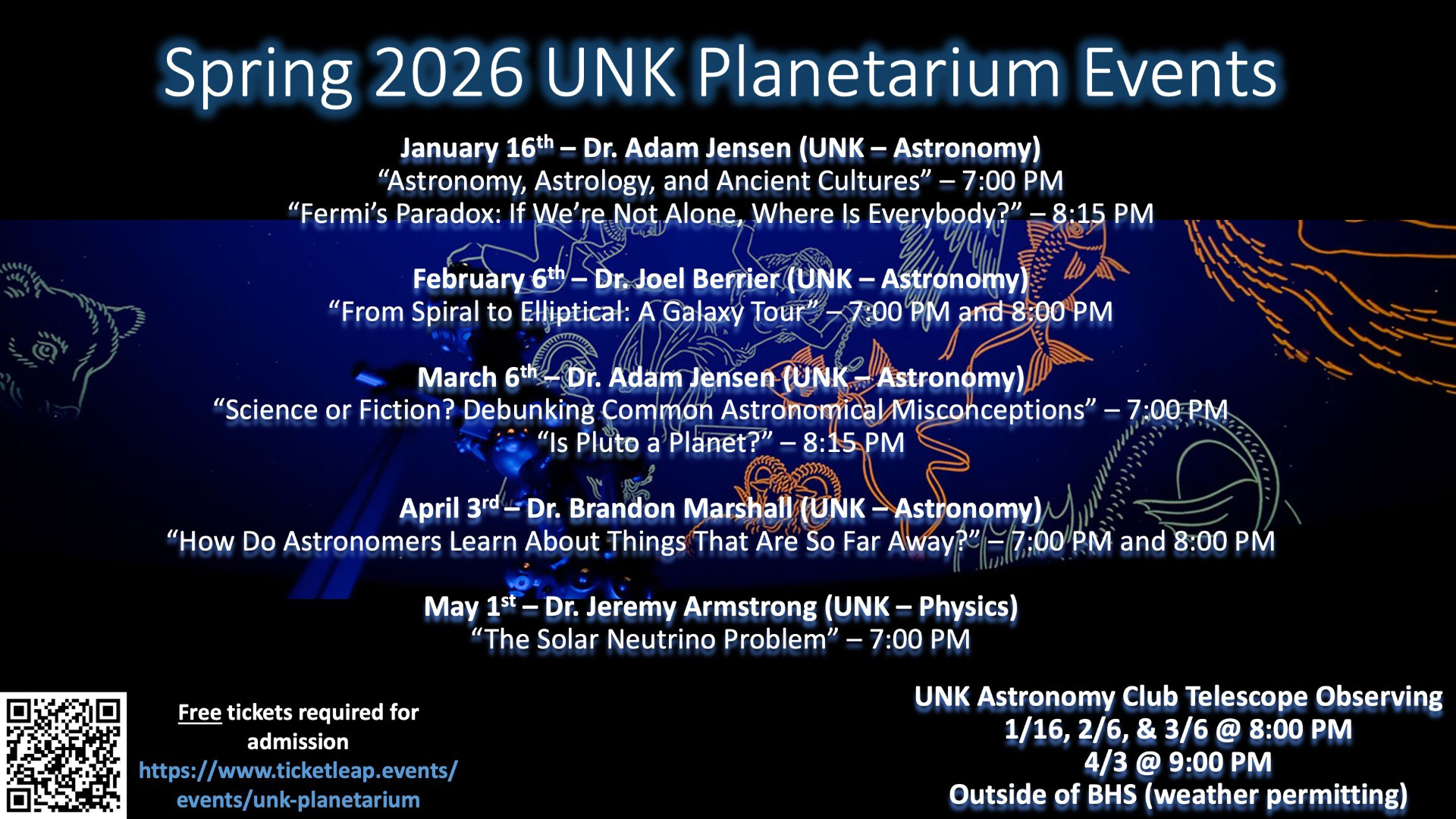
Led by faculty from the UNK Department of Physics and Astronomy, the “Astro Friday” series takes guests on a journey through space while answering some fascinating cosmic questions.
The spring lineup features:
- 7 p.m. Jan. 16 – “Astronomy, Astrology and Ancient Cultures,” presented by professor Adam Jensen. Throughout recorded history, humans have paid attention to the skies, for reasons ranging from curiosity and wonder to the belief that celestial objects influence and foretell the events of our lives. This presentation explores ancient cultures’ connection to the sky and the relationship between the practices of astronomy and astrology.
- 8:15 p.m. Jan. 16 – “Fermi’s Paradox: If We’re Not Alone, Where Is Everybody?” presented by Jensen. Legend states that 20th century physicist Enrico Fermi, in a casual conversation with friends about rumored UFO sightings, blurted out, “But where is everybody?” This question, often referred to as Fermi’s Paradox, summarizes the apparent conflict between the lack of clear and widely accepted evidence for extraterrestrial life and the estimates (by some) that life is plentiful even in our local region of the Milky Way. This presentation covers the basic parameters of Fermi’s Paradox, how scientists estimate the prevalence of life, and possible resolutions – conventional or otherwise – to the issue.
- 7 and 8 p.m. Feb. 6 – “From Spiral to Elliptical: A Galaxy Tour,” presented by associate professor Joel Berrier. Our observations of the universe around us have led to the discovery of numerous galaxies. Through images provided by modern telescopes and computer simulations, this presentation will explore the diverse shapes and lives of these galaxies. Guests will witness galactic collisions, star formation and the slow transformations driven by gravity and time.
- 7 p.m. March 6 – “Science or Fiction? Debunking Common Astronomical Misconceptions,” presented by Jensen. Astronomy is a source of fascination for many, but there are a variety of misconceptions about planets, stars, galaxies and more that persist for various reasons, including social media posts and depictions in books, movies and television. This presentation will address and correct some of those astronomical misconceptions, from the common to the obscure.
- 8:15 p.m. March 6 – “Is Pluto a Planet?” presented by Jensen. At the time of its discovery in 1930, Pluto was considered the sought-after “Planet X,” the ninth planet in the solar system. It remained that way until 2006, when the International Astronomical Union controversially voted on a new definition for “planet” that moved Pluto to the status of “dwarf planet.” The situation ignited the interest and passion of the public, many of whom rallied to Pluto’s defense – how could the IAU demote poor, tiny Pluto? But what objects have been considered planets throughout history? Is the IAU’s definition a good one? What other objects like Pluto are out there? These questions and more will be discussed.
- 7 and 8 p.m. April 3 – “How Do Astronomers Learn About Things That Are So Far Away?” presented by associate professor Brandon Marshall. Astronomers use large telescopes to study the universe. However, space is so vast that even with the largest telescopes, planets, stars and even galaxies can appear just as dots. Come learn about some of the techniques that astronomers use to learn so much from such small points of light in the sky.
- 7 p.m. May 1 – “The Solar Neutrino Problem,” presented by professor Jeremy Armstrong. Neutrinos are particles produced in some nuclear processes. The sun produces them as it burns hydrogen into helium. In the 1960s, Ray Davis and John Bahcall set out to measure them. In a tank of dry-cleaning fluid deep within South Dakota’s Homestake Mine, Davis measured one-third the amount of neutrinos that were predicted by Bahcall’s calculations. This discrepancy was dubbed “The Solar Neutrino Problem.” Subsequent experiments in Japan, the Soviet Union and Italy confirmed the problem. Many solutions were proposed, including the eventual answer: neutrino oscillations. In 2001, the Sudbury Neutrino Observatory in Ontario, Canada, published results that confirmed neutrino oscillations and solved the problem, leading to Nobel Prizes for Davis in 2002 and others for neutrino oscillations in 2015.
Admission to the planetarium shows is free, but attendees are required to reserve a ticket at https://www.ticketleap.events/events/unk-planetarium. Tickets will be available one week before each show. Walk-ins will be allowed if seating is available.
Weather permitting, the UNK Astronomy Club will offer telescope observing sessions in conjunction with most shows. Those sessions are scheduled for 8 p.m. Jan. 16, Feb. 6 and March 6 and 9 p.m. April 3 outside the Bruner Hall of Science.
Located inside the Bruner Hall of Science on campus, the UNK Planetarium is accessible and can accommodate one or two wheelchairs per show.
For more information, visit the UNK Planetarium FAQ page or contact Jensen at jensenag@unk.edu.